
 Les Aperettes
https://www.amallte.com/wp-content/uploads/2019/10/communaute.jpg
432
968
Louis-Pierre Guillaume
https://www.amallte.com/wp-content/uploads/2022/03/Logo-Amallte-horizontal-blue-small-WP-200x54-1.png
Louis-Pierre Guillaume2020-08-24 17:40:392020-09-22 10:29:38Collaborative Innovation: How to lead remote communities?
Les Aperettes
https://www.amallte.com/wp-content/uploads/2019/10/communaute.jpg
432
968
Louis-Pierre Guillaume
https://www.amallte.com/wp-content/uploads/2022/03/Logo-Amallte-horizontal-blue-small-WP-200x54-1.png
Louis-Pierre Guillaume2020-08-24 17:40:392020-09-22 10:29:38Collaborative Innovation: How to lead remote communities?The community of practice, an innovative organizational solution
Issues within organisations
An organization without an active community is less able to innovate, takes longer to bring newcomers up to speed in their positions, capitalizes less on critical knowledge, and risks losing critical knowledge when key people leave.
Communities of practice survive as long as their members find value in their involvement in the community
Amallte is an expert in engaging virtual communities and implementing a large-scale community of practice program.
Communities of Practice
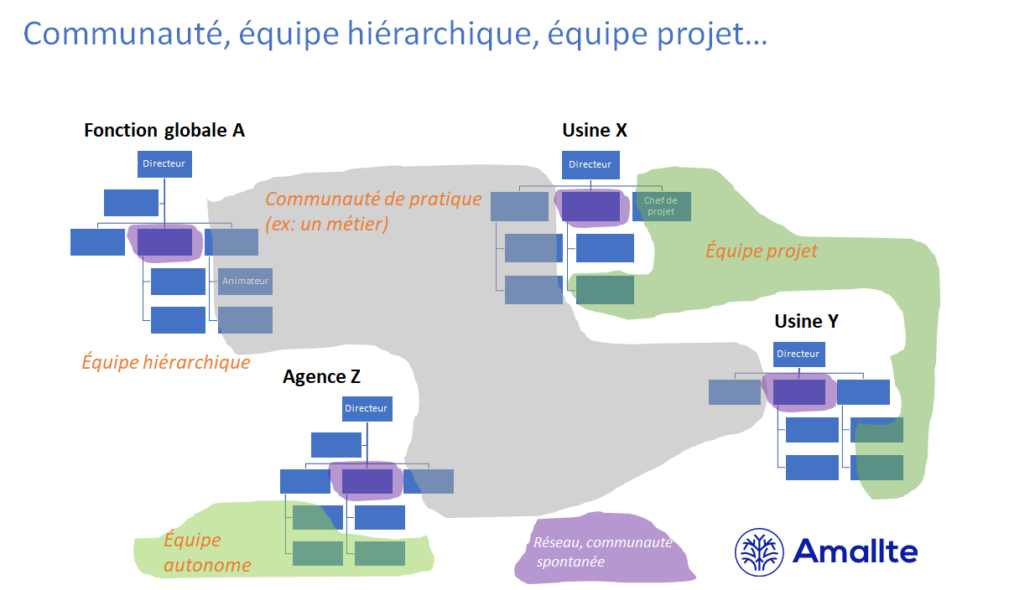
A community is a group of individuals who share a common passion for a given field of knowledge. The regular interactions and sharing of best practices between members of a community constantly generate a lot of new ideas. This creativity can naturally be seen as a powerful source of innovation for organizations.
Collaboration with communities of practice requires the implementation of new management methods. These informal groups are increasingly playing the role of real active units in the innovation process, through which creative ideas emerge, are validated, tested and implemented. They also play an active role in situated learning processes and business process improvement.
Virtual Communities of Practice (VCoP) facilitate learning and knowledge sharing between employees located in different sites or countries, via the enterprise social network (ESR).
Communities of practice are the subject of numerous scientific publications by researchers (E. Wenger, J.P. Bootz, P. Lievre, A. Haas, P. Cohendet…).
Innovative solution by Amallte regarding Communities
Amallte’s innovative solution mixes several modes of appropriation on how communities are built and led. We follow a bottom-up approach. We consult stakeholders (existing community leaders, community members, department/BU managers, etc.) via a survey and a few workshops, either face-to-face or remote. Then we make an inventory of the cross-functionality needs (innovation, learning, process…) and suggest potential communities. We use our community maturity model, designed from research in this field.
We co-construct a model of communities of practice, adapted to the culture of the organization and to existing communities, which will allow future community leaders to take ownership and to quickly increase their competencies, in particular when the members of these communities are located on different sites (virtual communities).
We are also co-constructing a governance model for all the communities, via a community of communities. We will facilitate the development of the internal team in charge of developing the communities.
We help these virtual communities of practice to rely on the enterprise social network (Yammer, Workplace, etc.) to facilitate mutual exchanges and support between members. We propose knowledge management methods, used by other organizations, to capitalize and reuse the community’s knowledge.
Translated with www.DeepL.com/Translator (free version)
Actions
- Boost the remote animation of your virtual community => Special offer 390€ HT
- One-day training on communties of practice => Training catalog
- Customized coaching service. Contact- us !
Amallte mixes practice and research
To know more about the links between practitioners on CoPs and research on CoPs, click here
Case study
Articles about communities
Les Aperettes
https://www.amallte.com/wp-content/uploads/2019/10/communaute.jpg
432
968
Louis-Pierre Guillaume
https://www.amallte.com/wp-content/uploads/2022/03/Logo-Amallte-horizontal-blue-small-WP-200x54-1.png
Louis-Pierre Guillaume2020-08-24 17:40:392020-09-22 10:29:38Collaborative Innovation: How to lead remote communities? https://www.amallte.com/wp-content/uploads/2020/02/Team-Monarchy-Community.png
240
855
Louis-Pierre Guillaume
https://www.amallte.com/wp-content/uploads/2022/03/Logo-Amallte-horizontal-blue-small-WP-200x54-1.png
Louis-Pierre Guillaume2020-02-23 22:19:232022-03-14 10:23:54Community. Team. What is the Difference?Les Aperettes
https://www.amallte.com/wp-content/uploads/2019/10/communaute.jpg
432
968
Louis-Pierre Guillaume
https://www.amallte.com/wp-content/uploads/2022/03/Logo-Amallte-horizontal-blue-small-WP-200x54-1.png
Louis-Pierre Guillaume2019-10-20 19:15:572022-02-06 19:48:55The Communities, a New Model of Organization?
https://www.amallte.com/wp-content/uploads/2020/02/Team-Monarchy-Community.png
240
855
Louis-Pierre Guillaume
https://www.amallte.com/wp-content/uploads/2022/03/Logo-Amallte-horizontal-blue-small-WP-200x54-1.png
Louis-Pierre Guillaume2020-02-23 22:19:232022-03-14 10:23:54Community. Team. What is the Difference?Les Aperettes
https://www.amallte.com/wp-content/uploads/2019/10/communaute.jpg
432
968
Louis-Pierre Guillaume
https://www.amallte.com/wp-content/uploads/2022/03/Logo-Amallte-horizontal-blue-small-WP-200x54-1.png
Louis-Pierre Guillaume2019-10-20 19:15:572022-02-06 19:48:55The Communities, a New Model of Organization?